Freedom's Footprints: Danville's Secret Role in the Underground Railroad
Most visitors come to Danville for the rolling hills, the distillery tours, or the charming downtown square. But beneath the surface of this picture-perfect Kentucky town runs a much deeper current — one that carried desperate human beings toward freedom at enormous personal risk to everyone involved. The Underground Railroad wasn't a single road or a tidy network with a headquarters. It was a constellation of whispered promises, back-door handshakes, and split-second decisions. And Danville, sitting at the heart of central Kentucky, played a role that history has been slow to fully acknowledge.
Why Danville Mattered Geographically
To understand Danville's place in the Underground Railroad story, you have to think like a freedom seeker in the 1840s or 1850s. You're moving at night. You're reading the stars. You need water, shelter, and someone willing to look away — or better yet, actively help. Danville's location in Boyle County made it a natural crossroads. The Dick's River corridor offered cover and a route northward, while proximity to larger roads meant conductors could move people with a degree of plausible deniability.
Dr. Anne Marshall, a Kentucky historian who has spent years combing through period documents and Freedmen's Bureau records, notes that Danville was never an obvious node on the network precisely because it was so embedded in the slaveholding economy. "The courage required here was different," she explains. "This wasn't a Northern abolitionist town. People who helped here risked everything — social standing, property, legal consequences, physical safety."
The Names History Almost Forgot
Local archives at the Boyle County Public Library and the Centre College special collections hold fragments of a story that's still being pieced together. Court records from the antebellum period occasionally surface references to "harboring" cases — legal proceedings against individuals accused of helping enslaved people escape. These documents, while frustratingly incomplete, point to a network that was more active than the official history of the region has typically admitted.
One name that does appear in multiple local accounts is that of a free Black community that established roots on the edges of Danville in the decades before the Civil War. Free Black residents occupied a precarious legal position in Kentucky, but their homes and churches sometimes functioned as informal safe houses — places where a freedom seeker could rest for a few hours before moving on. The exact locations of many of these gathering points remain unclear, but oral histories passed down through families in the region suggest they were more numerous than documented records indicate.
There's also the story of several Danville-area Presbyterians — not surprising given the town's deep connection to the Presbyterian faith and the founding of Centre College — who quietly used their religious networks to pass information and resources northward. The relationship between faith and abolition was complicated in Kentucky, where many church leaders refused to take a public stance. But private conviction sometimes drove action that public statements never would.
Visiting the Sites That Remain
For history-minded visitors, Danville offers several places worth a thoughtful visit — though it's worth noting upfront that this isn't a polished heritage trail with interpretive signs on every corner. That's actually part of what makes it authentic.
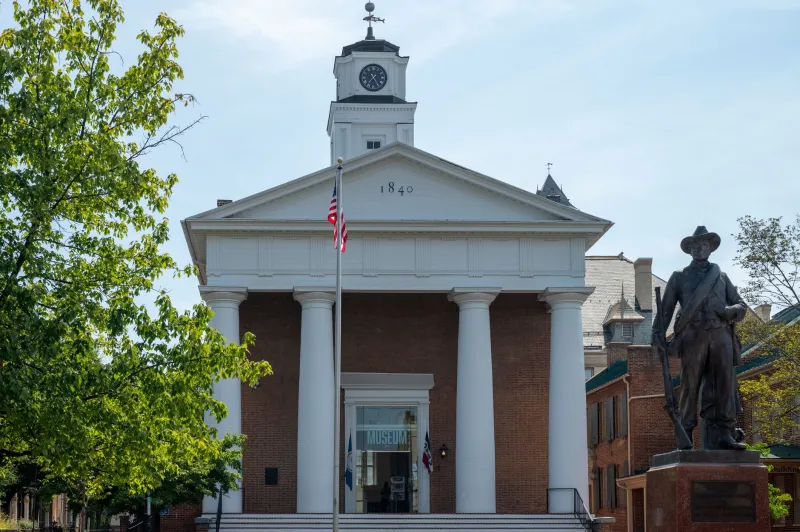
Constitution Square Historic Site is the obvious starting point for any deep dive into Danville's past. While the site is primarily known as the location where Kentucky's first constitution was drafted, the square and its surroundings were also the center of public life during the antebellum period — including, grimly, the slave trade. Standing here and understanding that duality is a powerful entry point into the larger story.
The McDowell House & Apothecary Museum on Second Street, famous as the site of the first successful ovariotomy in medical history, sits in a neighborhood that was home to some of Danville's most prominent citizens in the 1800s. The social networks of that era — who knew whom, who had the resources to help, who had reason to look the other way — ran directly through this part of town.
Berea College, about 45 minutes from Danville, is an essential companion stop for anyone exploring this history. Founded explicitly on abolitionist principles, Berea's archives contain extensive documentation of the freedom movement throughout central Kentucky and can provide crucial regional context for Danville's role.
Locally, the Boyle County African American Heritage Organization has been working to document and preserve the histories of Black families in the region — many of whom are direct descendants of freedom seekers and free Black community members from the antebellum period. Reaching out before your visit is highly recommended; their knowledge of the landscape is irreplaceable.
Listening to Descendants
Perhaps the most moving part of researching this history is connecting with families who carry it in their bones. Several longtime Danville-area residents with deep roots in the local Black community describe growing up with family stories that were never quite confirmed but never quite forgotten either — accounts of great-great-grandparents who "came through" Danville, or of ancestors who helped others do the same.
James Whitfield, whose family has lived in Boyle County for generations, puts it plainly: "We always knew there was more to this place than what the history books said. Our grandparents knew things they didn't always talk about out loud. But they knew."
That kind of embodied, inherited knowledge is exactly what academic historians are now working harder to incorporate into the official record. The story of the Underground Railroad in places like Danville was never meant to be written down — its survival depended on secrecy. Reconstructing it now requires humility, patience, and a willingness to treat oral history as evidence.
Why This History Belongs in Every Danville Visit
Danville is genuinely proud of its past, and rightly so. It's a town that gave Kentucky its constitution, produced a pioneering surgeon, and built institutions that still define the community today. But a complete reckoning with that past means holding the uncomfortable truths alongside the celebrated ones.
The people who passed through Danville on their way to freedom — and the people who risked everything to help them — deserve to be part of the story this town tells about itself. Not as a footnote, but as a central chapter. Visiting with that awareness doesn't diminish the beauty of this place. If anything, it deepens it.
If you're planning a trip to Danville with history on your mind, set aside at least half a day to walk slowly through the older parts of town. Read the historical markers carefully, but also read between the lines. Ask questions at the local library. Talk to people. The full story of this place is still being told — and it's well worth hearing.